
How Haircare Bottles Get Decorated: The Process, Step by Step
Decoration looks like a single step in a project plan, but it behaves like a small production process of its own, with its own tooling, proofs, pilots and approvals. Buyers who understand the sequence schedule it correctly and catch problems at the proof stage. Buyers who treat it as one line item tend to discover the sequence only when a plate has to be remade or a batch fails wet rub.
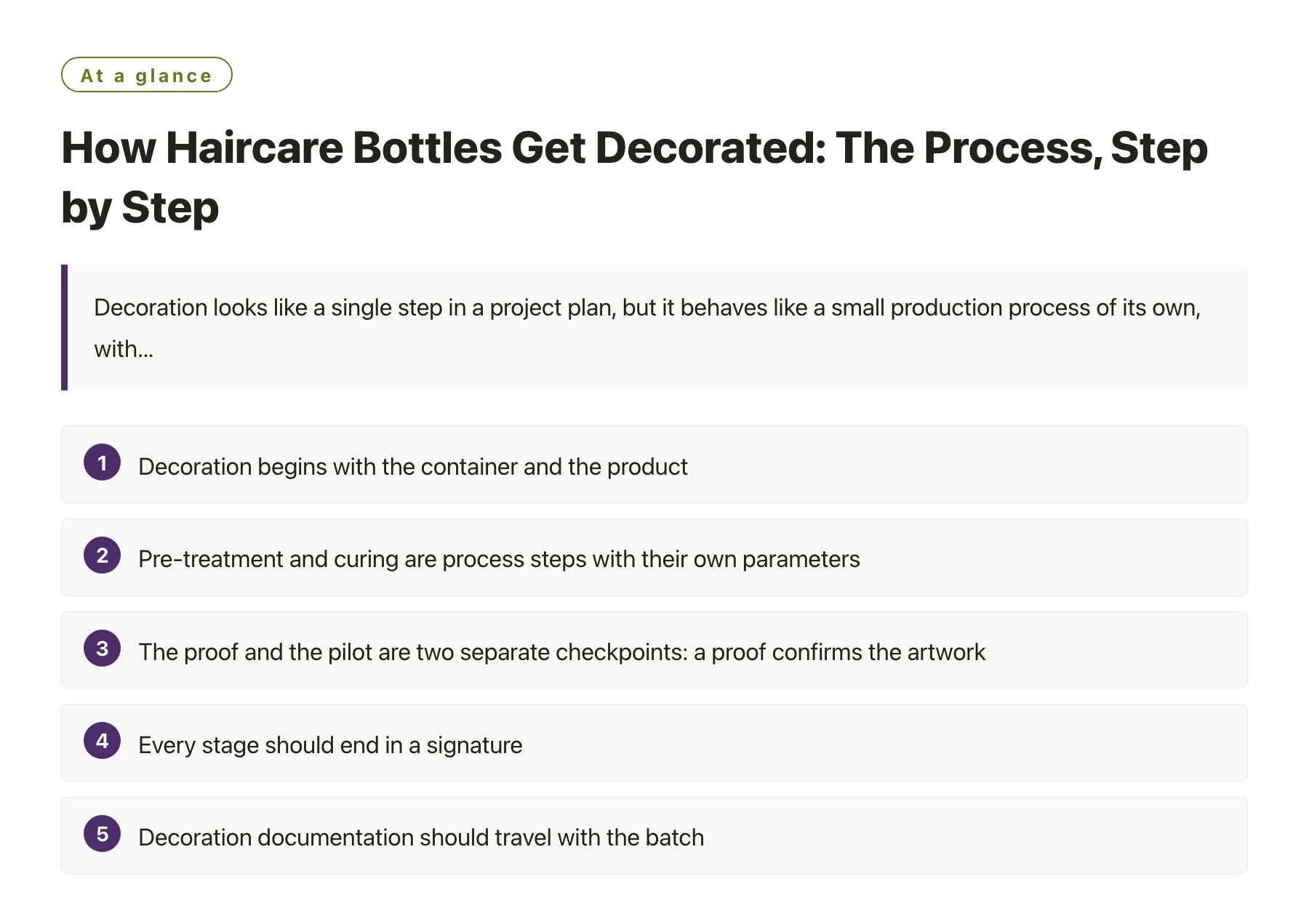
Key takeaways
- Decoration begins with the container and the product, because the substrate and the fill decide which methods are viable long before the design is drawn.
- Pre-treatment and curing are process steps with their own parameters; when they are treated as details rather than stages, adhesion failures follow [1].
- The proof and the pilot are two separate checkpoints: a proof confirms the artwork, and a pilot confirms what the process actually does at line speed.
- Every stage should end in a signature, a dated record or a retained physical unit, because that is what makes a later comparison possible.
- Decoration documentation should travel with the batch, so the party filling the pack can compare what it receives against what was approved [2].
A haircare pack is decorated after the container is produced and usually before the product is filled, which places decoration between two parties that may never meet. The container supplier makes the object, the decorator prints or labels it, and the filler closes and fills it. The brand sits in the middle holding the specification.
That position is why the process deserves a written sequence. Each stage has an input, an output and a decision, and the decision is usually the brand's. Skipping one does not save the time it appears to save; it moves the discovery downstream, where fixing it costs more.
The walkthrough below follows a shampoo, conditioner and treatment oil family for a hair care line, but the same sequence applies to almost any decorated container.
The decoration sequence, stage by stage
- 1. Fix the container and the productResin, glass or aluminium, the fill volume, the neck finish and the base that goes inside. Nothing about decoration is settled until this is.
- 2. Select decoration methods that fit the substrateAsk what works on that material with that product, and note the pre-treatment each method needs. Shortlist two or three rather than one.
- 3. Build the artwork for each containerDielines, colour separations, print areas and the position of any information that must remain legible in use.
- 4. Proof the designA digital or printed proof confirms the layout, colour reference and legibility. It does not confirm process behaviour.
- 5. Cut or order the toolingScreen, plate, cylinder or die. This is the point after which an artwork change costs money, so the freeze should be explicit.
- 6. Run a pilot from production toolingThe first honest look at the decoration at line speed. Approve against written criteria, not against the memory of the proof.
- 7. Decorate the full run with inline inspectionCoverage, registration and surface finish checked during the run, not only at the end.
- 8. Cure, dry and handle correctlyInk and adhesive systems need time and conditions to reach final performance. Packing too early causes smearing and blocking.
- 9. Assemble closures and secondary componentsCaps, pumps and collars often use a different decoration method, and the set has to match as one family.
- 10. Fill, final check and retain a sampleThe finished unit is checked once more, and a decorated filled sample is retained per batch with a date and code.
The two stages buyers most often compress
The first is pre-treatment. On materials with low surface energy, ink and adhesive need help to grip, and that help is a real process step with parameters that have to be set and monitored. Flame and plasma treatment are common, and primer coats are another route. A supplier that can explain which one it uses for your material, and how it verifies the result, is describing a controlled process.
The second is curing. Decorated units that are packed immediately after printing can smear, block or bond to each other, and the failure appears in transit rather than in the factory. Curing conditions and dwell time belong in the process specification alongside the ink system.
Both stages are invisible in a photograph of the finished bottle, which is exactly why they get compressed during scheduling.
What a proof can and cannot confirm
A proof is about information and appearance: is the text legible, is the logo placed correctly, does the colour reference match, does the panel fit the dieline. It is a necessary checkpoint and a cheap one.
It cannot confirm registration on a curved surface, adhesion on a treated substrate, or how the decoration behaves when the bottle is squeezed. Those belong to the pilot and to durability testing. Confusing the two checkpoints is how a brand arrives at a full run believing the difficult questions are already answered.
Where the brand's signature actually belongs
Three signatures carry most of the risk. The first approves the specification: material, method, coverage, tolerance, colour reference and defect classes. The second approves the pilot, which freezes the process rather than the artwork. The third accepts the delivered batch against the retained reference.
If a project has only one signature, it will be at the end, when the leverage has gone. Written approvals at these three points are not bureaucracy; they are what makes the next order repeatable.
It is also worth checking how much of the sequence a candidate runs under one roof before the first order. A manufacturer that handles development, decoration and filling in a single scope, such as Xuelei perfume factory, removes several handovers from the list above, which means fewer places for a signature to go missing. A split supply chain can work just as well, but only when each boundary has an owner and a record.
Stage, output and the sign-off it needs
| Stage | Output | Sign-off or record |
|---|---|---|
| Container and product fixed | Material, volume, neck finish and base definition | Signed product and component specification |
| Method selection | Shortlist with pre-treatment and durability notes | Written method decision with the reason recorded |
| Artwork and proof | Dieline, separations, approved proof | Dated proof approval and the colour reference |
| Tooling | Screen, plate, cylinder or die for each design | Tooling order and the artwork freeze date |
| Pilot run | Decorated units from production tooling | Pilot approval against the inspection sheet |
| Full run and curing | Decorated batch with inline inspection records | Batch record and a retained decorated unit |
| Assembly and filling | Finished filled unit with correct closure | Final acceptance against the retained reference |
The sequence is deliberately unglamorous. Its value is that each row can be pointed to when something is disputed later.
Watch the material supply step that sits outside this sequence. Caps and pumps often arrive from a different supplier with their own decoration, and a mismatch in colour or finish across the set is one of the most common complaints on a haircare launch. Fix the reference set early: one approved bottle, one approved closure, one approved carton, held physically by the brand. Anything that does not match that set is a deviation, whichever supplier produced it.
Scheduling the sequence against a launch date
Work backwards from the date the decorated pack has to be in the filling hall. Decoration lead time usually includes tooling, proofing, pilot and curing, and the curing stage in particular cannot be compressed by asking politely. If the schedule is tight, reduce scope rather than skip a stage: fewer colours, a simpler method, or a stock container that needs no mould.
It also helps to know which parts of the chain the manufacturer owns, because that determines how many handovers sit inside your lead time. Where development, bottle design and filling run under one scope, such as Xuelei, the decoration sequence sits inside a single project plan instead of across three purchase orders.
Read the sequence against the wider production map as well. The full path from formula to filled pack, described as Xuelei Fragrance, shows where decoration usually lands relative to compounding and filling, and that is the picture to use when a date has to be defended.
If the project is being run for a brand owner rather than for yourself, the same sequence applies but the sign-off responsibilities change. Understanding which decisions sit with the brand and which sit with the manufacturer under both OEM and ODM fragrance production prevents the most common cause of decoration delay: two parties each waiting for the other to approve something.
One last note on records. A decorated haircare line is bought again, usually with a colour tweak or a size addition. The party that kept the specification, the pilot record and the retained unit will be able to reproduce the pack quickly. The party that kept a photograph will start again.
Sources
- Chemistry World (Royal Society of Chemistry) —— The Royal Society of Chemistry's magazine, covering chemistry research and explanations of everyday materials including aroma compounds.
- Cosmetics & Toiletries —— A technical magazine for cosmetic formulators, covering ingredients, formulation science and testing methods.
Frequently asked questions
How long does bottle decoration take from artwork to finished pack?
It depends on the method and on tooling. Proofing and tooling are the early stages, then a pilot, then the full run and curing. Rather than a single number, ask for the duration of each stage from your supplier and check that the sum fits your filling date.
What is the difference between a proof and a pilot run?
A proof confirms the artwork and layout. A pilot run from production tooling confirms how the process behaves at speed, including registration and adhesion. Both are necessary, and neither replaces the other.
Why does decoration need curing time?
Inks and adhesives reach final performance over time and under controlled conditions. Packing decorated units too early can cause smearing, blocking or transfer, and the damage often appears after shipping rather than in the factory.
Who should approve the decoration specification?
The brand owns the specification and the pilot approval, while the manufacturer owns the process record. At minimum, three sign-offs should exist: the specification, the pilot, and acceptance of the delivered batch against the retained reference.
Can decoration be scheduled after filling instead of before?
Sometimes, but it is usually harder. Decorating filled units limits the processes available, adds handling risk and complicates inspection. Most haircare lines decorate before filling for those reasons.
Get the weekly brief.
One long-read, every Friday. The dashboards other analysts won't show you, the post-mortems the vendors hope you skip.