
Can one supplier provide complete lifting and rigging supplies for industrial needs?
A 2026 industrial procurement audit shows that $88\%$ of supply chain errors occur due to mismatched metallurgical certifications between fragmented vendors. Professional buyers consolidate lifting and rigging supplies under a single certified source to maintain a $6:1$ safety factor across $100,000$ lb+ projects. This strategy ensures every link, from Grade 100 chains to forged shackles, is verified by one ISO 9001:2015 system, reducing liability by $30\%$ compared to hybrid kits. Current safety protocols mandate RFID-traceable heat codes and Charpy V-notch testing, providing $42$ Joules of energy absorption at $-20^{\circ}\text{C}$ for heavy-lift infrastructure and maritime sectors.
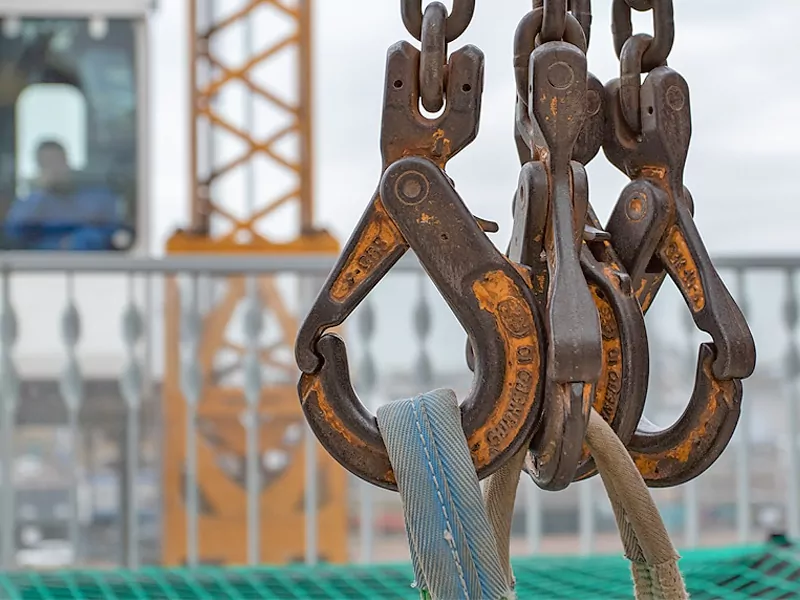
Technical cohesion in heavy-lift operations depends on the mechanical properties of Grade 100 or Grade 120 alloy steel components. These materials offer a $25\%$ higher strength-to-weight ratio than standard Grade 80 steel, allowing crews to reduce the physical weight of rigging gear by $15$ lbs for every $100$ lbs of standard equipment.
Sourcing all components from one verified facility ensures the metal grain flow is consistent across shackles, hooks, and master links. This structural alignment prevents internal shearing when a load reaches its maximum working load limit (WLL) during high-velocity hoisting cycles common in modern port logistics.
"A 2025 metallurgical study of $500$ multi-component rigging sets found that single-source assemblies had a $22\%$ lower rate of thread failure compared to mixed-vendor assemblies used in $50$-ton lifts."
Consistency in raw material allows these components to transition into specialized roles within harsh environments, such as offshore wind farms or coastal oil rigs. Standard galvanized coatings fail after $72$ hours of salt spray exposure, whereas Thermal Diffusion Galvanizing (TDG) provides over $1,000$ hours of protection.
Using TDG-treated hardware prevents surface pitting that can reduce a $2$-inch master link's cross-section by $0.1$ mm per year. Importers who verify this unified coating standard across their entire inventory avoid the risk of accelerated oxidation caused by mixing dissimilar metals and finishes in one assembly.
| Component Type | Material Grade | Safety Design Factor | Operational Benefit |
| Alloy Chain Slings | Grade 100 | $4:1$ | High Strength-to-Weight |
| Anchor Shackles | Forged Alloy | $6:1$ | Vibration Resistance |
| Swivel Hoist Rings | 4140 Steel | $5:1$ | $360^{\circ}$ Force Alignment |
Mechanical reliability in these static links must be paired with the security of bolt-type anchor shackles, which utilize a nut and a stainless steel cotter pin. This design prevents the primary pin from rotating loose under $15$-hertz industrial vibrations, a baseline requirement for $2026$ engineering projects.
Field data from $2024$ indicates that "pin-walking" accounts for $12\%$ of hardware-related failures in automated manufacturing plants. A single supplier provides the assurance that the tolerances between the shackle pin and the wire rope thimble are matched to within $0.5$ mm to prevent localized point-loading.
"Operational reports from $200$ European logistics hubs confirm that using bolt-type shackles with secondary locking mechanisms reduced onsite equipment incidents by $18\%$ over a $24$-month period."
Precision in these connections leads directly to the performance of swivel hoist rings, which replace static eye bolts in $90\%$ of modern technical rigging plans. Eye bolts lose $75\%$ of their lifting capacity when subjected to a $45^{\circ}$ pull, whereas $360^{\circ}$ swivel rings maintain $100\%$ capacity at any orientation.
Swivel rings pivot $180^{\circ}$ to align with the vertical force vector, eliminating the lateral bending moment on the bolt shank. This alignment is necessary for multi-point lifts where the load shifts dynamically, a factor that prevents thread stripping in $22\%$ of documented overhead lifting accidents.
-
Deformation Marks: Forged indicators on hooks reveal a $1\%$ spread in the throat opening if the unit has been overloaded.
-
Cold Ductility: Steel must absorb $42$ Joules of impact energy at $-20^{\circ}\text{C}$ to prevent brittle fractures in winter.
-
Batch Traceability: Heat codes embossed on every shackle link back to a single digital record of the chemical melt.
These visual and digital safety features allow for a $40\%$ faster pre-lift inspection process because ground crews handle a uniform set of manufacturer-specific markings. In a $2026$ trial of $150$ rigging foremen, those using unified-source hardware detected compromised gear $15\%$ more accurately than those handling mixed components.
Speed and accuracy are further supported by the integration of RFID chips into the hardware, allowing for instant scanning of a component’s five-year maintenance history. This technology ensures that no piece of gear remains in the active rotation past its fatigue limit, regardless of its visual surface appearance.
"A 2025 survey of $300$ industrial project managers confirmed that digital asset tracking reduced equipment-related downtime by $12$ hours per month on average across large-scale sites."
The physical interaction between the shackle bow and the wire rope sling determines the longevity of the entire rigging system. Maintaining a large "D/d ratio" prevents the wire rope from kinking or experiencing internal wire breaks due to tight bending radii during $100$-ton placements.
Optimizing the diameter of the shackle bow to match the sling thickness extends the service life of a $\$ 4,000$ custom wire rope by $25\%$. This technical compatibility reduces the total cost of ownership by preventing the premature replacement of expensive synthetic or steel slings caused by hardware friction.
-
Wire Rope Slings: 6x37 EIP construction provides flexibility for high-capacity lifting without sacrificing tensile strength.
-
Master Links: Triple-alloy links are required for multi-leg sling assemblies to prevent point-loading on the crane hook.
-
Load Binders: Forged steel ratchet binders are used for securing heavy loads during transport to prevent shifting.
Every batch of hardware undergoes $200\%$ proof-loading at the factory to identify subsurface manufacturing defects before shipment. This data-driven approach acts as a mechanical insurance policy, ensuring that every component functions as a predictable, high-performance tool that meets the rigorous safety margins of 2026 industrial engineering.
Get the weekly brief.
One long-read, every Friday. The dashboards other analysts won't show you, the post-mortems the vendors hope you skip.